


PROSPECTS REQUESTING SERVICEAI System Icon
• These prospects requested service through our website and have already been introduced to the Load Analyzer.
• Click the Prospect’s STATE to view their information and learn more about their needs.
• TEXT LOAD ANALYZER LINK: Click EDIT → T → MODIFY. (Pg Tag - 8f7)


Load Analyzer App:
  • $15 one-time download fee
  • Helps prospects evaluate loads before accepting them
  • Allows prospects to request Company Driver or Owner Operator services directly through the app.
  • The Load Analyzer is also included in the CDL Profit Trainer, Company Drivers, Owner Operators, and Carriers Dispatch apps.
HOW TO CONVERT COMPANY DRIVER INTO THE COMPANY DRIVER APP SERVICE

START BY GETTING TO KNOW THE DRIVER

COMPANY TRUCK DRIVERS APP SERVICE AI System Icon

Sales, Training and Client Enrollment Playbook

BEFORE YOU BUY A TRUCK, LEARN HOW TO MAKE THE TRUCKING BUSINESS WORK.

A practical guide for helping Class A CDL Company Drivers prepare for Owner Operator ownership while continuing to drive their employer's truck.


1. THE COMPANY DRIVER'S BIGGEST CHALLENGE

You may know how to drive an 18-wheeler, but do you know how to operate a trucking business?

Many Company Drivers dream of buying their own truck to make more money, become independent, and control their future.

But buying a truck also means taking responsibility for fuel, insurance, repairs, maintenance, equipment payments, loaded and empty miles, and business expenses.

A truck can generate thousands of dollars in revenue while the owner still loses money.

Knowing how to drive a truck does not mean knowing how to make the trucking business profitable.

That is why Eye1 encourages Company Drivers to learn the business side before investing thousands of dollars in equipment.

2. THE EYE1 COMPANY DRIVERS OPPORTUNITY

The Eye1 Company Drivers app helps Class A CDL drivers begin learning how to evaluate trucking operations before purchasing their own equipment.

You can begin while driving your employer's truck.

Instead of relying only on what other Owner Operators say they earn, you can learn to understand loaded and empty miles, operating expenses, freight rates, and Profitability Evaluation Status (PES).

The goal is to help you develop business knowledge before taking on the financial risks of ownership.

Don't buy a truck just because you know how to drive one. Learn how the business works first.

3. SIX QUESTIONS THAT GET THE DRIVER'S ATTENTION

1. Are you thinking about buying your own truck to make more money?
2. Do you know how much money your truck would need to earn to cover expenses and build profits?
3. Do you understand how loaded and empty miles affect the profitability of a trucking operation?
4. Would you like to learn how to recognize whether an operation is building profits or losses?
5. Would you rather discover costly business mistakes while driving your employer's truck than after investing thousands in your own?
6. If you could begin learning how to build profits as an Owner Operator before buying a truck, would you want to start now?

These questions help the driver understand why learning before ownership matters.

4. UNDERSTANDING THE DRIVER'S GOALS

Before explaining the app, ask what the driver wants to accomplish.

  1. Why do you want to become an Owner Operator?
  2. When are you planning to purchase a truck?
  3. How much money are you preparing to invest?
  4. What do you know about operating expenses and equipment costs?
  5. How would you determine whether a load is profitable?
  6. What concerns you most about owning your own trucking business?

Listen to the answers.

Some drivers want more money. Others want independence or the ability to build their own business.

Connect Eye1's training to the driver's personal goals.

5. HOW THE COMPANY DRIVERS APP WORKS

The Company Drivers app allows you to begin learning using the truck you already drive for your employer.

STEP 1 — CREATE YOUR ACCOUNT

Download the Company Drivers app and complete the required registration.

STEP 2 — COMPLETE ENROLLMENT TRAINING

Learn how the system works, what information to submit, and how to understand your results.

STEP 3 — LEARN WITH ACTUAL DRIVING ACTIVITY

Use your completed driving activity to practice understanding trucking operations.

STEP 4 — INCLUDE LOADED AND EMPTY MILES

Learn why every mile matters, whether the trailer is loaded or empty.

STEP 5 — FOLLOW PES

Understand whether the submitted operating results are moving in a positive or negative direction.

STEP 6 — DEVELOP BETTER BUSINESS DECISIONS

Practice evaluating loads, expenses, freight rates, fuel costs, and operating results before making an equipment investment.

The app is a learning tool. It does not mean you own your employer's truck, receive the freight revenue, or personally incur all of the employer's expenses.

6. UNDERSTANDING LOADED AND EMPTY MILES

Suppose you drive 700 loaded miles and 150 empty miles.

700 Loaded Miles + 150 Empty Miles 850 TOTAL MILES

If you evaluate only the 700 loaded miles, you leave out 150 miles that still required fuel, equipment use, and operating costs.

That is why Owner Operators must understand the difference between loaded miles and total operated miles.

The truck costs money to operate whether it is loaded or empty.

Learning this before purchasing a truck can help you make better-informed decisions later.

7. UNDERSTANDING PES

PES stands for Profitability Evaluation Status.

It helps show whether submitted operating results are moving in a positive or negative direction.

POSITIVE PES — PROFITS BUILDING

The submitted operating information indicates favorable results.

The driver can study what is contributing to those results.

NEGATIVE PES — LOSSES BUILDING

The submitted information indicates unfavorable results.

The driver can examine what may be causing the losses.

PES is used for training and operating guidance. For Company Drivers, the results are part of a learning exercise and do not represent the driver's actual personal business profits.

The goal is to learn how to recognize positive and negative operating results before becoming responsible for your own truck.

8. DEMONSTRATING REAL OPERATING RESULTS

Real examples can help Company Drivers understand why learning matters.

One Eye1 operating example recorded:

$94,963.62 Gross Revenue 12,337 Total Operated Miles $7.70 Approximate Gross Revenue Per Total Mile

But gross revenue is not the same as profit.

The important question is what remained after operating expenses.

SALES EXAMPLE

Lisa: Marcus, would you like to learn how a trucking operation produced these gross results?

Marcus: Yes.

Lisa: More importantly, would you like to understand the expenses, total miles, and decisions behind those results before buying your own truck?

Marcus: Definitely.

Lisa: That's what Eye1 training is designed to help you begin learning.

These historical results are examples, not promises of future earnings.

9. THE COMPLETE SALES CONVERSATION

Lisa — Eye1 Service Provider

Marcus — Company Driver

Lisa: Marcus, are you thinking about buying your own truck?

Marcus: Yes. I want to make more money and work for myself.

Lisa: That's understandable. But let me ask you something. Do you know how to make the trucking business profitable before you buy the truck?

Marcus: I know how to drive, but I'm still learning the business side.

Lisa: That's exactly why I wanted to speak with you. Once you own the truck, fuel, insurance, maintenance, repairs, and equipment payments become your responsibility.

Marcus: That's true.

Lisa: Do you know how to evaluate all your loaded and empty miles to determine whether an operation is building profits or losses?

Marcus: Not really.

Lisa: Would you rather learn how to make those decisions now, while driving your employer's truck, or after investing thousands in your own equipment?

Marcus: Before buying my own truck.

Lisa: That's what the Eye1 Company Drivers app is designed to help you do. You begin learning with your current driving activity, follow PES, and understand how operating expenses, freight rates, and total miles affect the business.

Marcus: So I don't need to own a truck?

Lisa: Correct. You can start learning while continuing your current job.

Marcus: How much does it cost?

Lisa: I'll explain the current app price and exactly what's included. First, do you agree that understanding the business before buying a truck could help you make a better ownership decision?

Marcus: Yes.

Lisa: Then let's review the price and training. If it fits your needs, we'll get your account started and schedule your Enrollment Training.

10. HANDLING COMMON OBJECTIONS

"I'M NOT READY TO BUY A TRUCK YET."

That's exactly why now is a good time to learn. You don't need to own a truck to begin preparing.

"I ALREADY KNOW HOW TO DRIVE."

Driving experience is valuable. But operating a trucking business requires additional knowledge about expenses, freight rates, equipment costs, and profitability.

"I CAN LEARN ON YOUTUBE."

Videos can provide useful information. Eye1 gives you a structured way to practice evaluating your own driving activity and operating results over time.

"I'LL JUST ASK OTHER OWNER OPERATORS."

Their advice may help, but their expenses, equipment, freight lanes, and financial goals may be different from yours. Learning how to evaluate an operation yourself is important.

"I'LL DOWNLOAD IT AFTER I BUY A TRUCK."

Why wait until your money is already invested to begin learning how the business works?

"I NEED TO THINK ABOUT IT."

Of course. Is your concern the price, the training, or whether the service will help you prepare for ownership?

11. CLOSING THE SALE AND ENROLLING THE DRIVER

Return to the driver's original goal.

Lisa: Marcus, you told me you want to own a truck, but you don't want to invest thousands without understanding the business. Is that correct?

Marcus: Yes.

Lisa: Would learning how to evaluate loaded and empty miles, expenses, and operating results before buying a truck help you prepare?

Marcus: Yes.

Lisa: Then let's review the current price and service terms. If everything makes sense, we can get your Company Drivers account started and schedule your Enrollment Training.

AFTER ENROLLMENT

  1. Download the Company Drivers app.
  2. Create the account.
  3. Schedule personalized Enrollment Training.
  4. Learn how to submit completed driving activity.
  5. Understand how to follow PES.
  6. Begin practicing with actual driving activity.
  7. Continue learning as operating conditions change.
Don't wait until after you buy the truck to begin learning how the business works.

12. THE FIRST 30 DAYS

WEEK 1 — GET STARTED

Create the account, complete Enrollment Training, and understand the information required.

WEEK 2 — LEARN ABOUT MILES

Submit completed driving activity and understand the difference between loaded and empty miles.

WEEK 3 — UNDERSTAND PES

Review positive and negative operating results and learn what affects them.

WEEK 4 — PRACTICE BUSINESS DECISIONS

Use what you've learned to better understand freight rates, operating expenses, and load decisions.

The first month is about building knowledge, not proving you're ready to purchase equipment.

13. PREPARE BEFORE OWNERSHIP

Eye1 encourages Company Drivers to consider a longer learning period, potentially a year or more, before deciding whether to purchase a truck.

WHY?

Because freight rates, fuel prices, seasonal demand, and operating expenses change.

Learning over time gives drivers more opportunities to understand different operating conditions.

A few good weeks do not prove that a trucking business will succeed.

Before purchasing equipment, drivers should also evaluate financing, insurance, maintenance reserves, taxes, legal responsibilities, and the risks of ownership.

The objective is not simply to become an Owner Operator. It is to become better prepared to operate a trucking business.

14. SUMMARY AND CONCLUSION

Company Drivers already know how to drive.

What they may not know is how to manage the financial responsibilities of owning a trucking business.

The Eye1 Company Drivers app helps drivers begin learning before purchasing equipment.

Using actual driving activity, drivers can practice understanding loaded and empty miles, operating expenses, freight rates, and PES.

The goal is to help drivers develop business knowledge and make more informed ownership decisions.

FINAL SALES MESSAGE

"You're already driving the truck.

But before you spend thousands of dollars buying your own, wouldn't it make sense to learn how to make the trucking business work?

Eye1 helps you begin learning with the truck you're already driving.

Why risk thousands before learning what your miles are actually producing?"

EYE1 COMPANY DRIVERS

LEARN BEFORE YOU INVEST.
PREPARE BEFORE YOU OWN.

Training and PES do not guarantee future earnings, profits, or successful truck ownership.


HOW TO CONVERT OWNER OPERATORS INTO THE OWNER OPERATOR APP SERVICE

OWNER OPERATORS APP SERVICEAI System Icon

Sales, Training and Client Activation Playbook

YOU ALREADY OWN THE TRUCK. NOW LEARN WHAT YOUR TRUCKING BUSINESS IS ACTUALLY PRODUCING.

A practical guide for helping Owner Operators understand their loaded and empty miles, operating expenses, completed loads, and Profitability Evaluation Status (PES).

TABLE OF CONTENTS

  1. The Owner Operator's Biggest Problem
  2. How the Eye1 Owner Operators Service Helps
  3. Six Questions That Get the Driver's Attention
  4. Understanding the Client's Operation
  5. How the Owner Operators App Works
  6. Understanding PES
  7. Demonstrating the Value With Real Results
  8. The Complete Sales Conversation
  9. Handling Questions and Objections
  10. Closing the Sale and Activating the Client
  11. The First 30 Days
  12. Summary and Conclusion

1. THE OWNER OPERATOR'S BIGGEST PROBLEM

Owner Operators work hard to keep their trucks moving. They find freight, negotiate rates, drive thousands of miles, purchase fuel, maintain equipment, and pay operating expenses.

But driving thousands of miles and generating thousands of dollars does not automatically mean the business is profitable.

An Owner Operator might gross $8,000 in one week and still struggle to understand how much money the business actually made.

Why?

Because gross revenue does not account for all operating expenses.

Fuel, maintenance, insurance, equipment payments, dispatching fees, factoring fees, and empty miles all affect the final result.

The most important question is not how much money the truck grossed. It is how much profit the entire operation is producing.

This is the problem Eye1 helps Owner Operators understand.

2. HOW THE EYE1 OWNER OPERATORS SERVICE HELPS

The Eye1 Owner Operators service helps active Owner Operators and Common Carriers understand their trucking operations using their own operating information.

Instead of depending only on gross revenue, rate per loaded mile, or general industry averages, the client can develop a clearer picture of the business.

The service helps Owner Operators:

  1. Understand what their loaded and empty miles are producing.
  2. Track completed loads and operating expenses.
  3. Follow their Profitability Evaluation Status (PES).
  4. Recognize when operating results are moving positively or negatively.
  5. Understand how changing freight rates and fuel prices affect their operation.
  6. Make better-informed business decisions using actual operating information.
Don't just focus on how much a load pays. Understand what your entire trucking operation is producing.

3. SIX QUESTIONS THAT GET THE DRIVER'S ATTENTION

Start the conversation with questions the Owner Operator can relate to.

  1. Have you ever grossed thousands of dollars driving your truck and still wondered, "Where did all the money go?"
  1. Do you know what all your loaded and empty miles are actually producing after operating expenses?
  1. Do you know whether your trucking business is currently building profits or losses?
  1. Would you like to recognize negative operating results before they become a bigger financial problem?
  1. Would it help to understand how changing fuel prices, freight rates, and operating expenses affect your profits?
  1. If you could use your own operating numbers to understand what your trucking business is producing, would you want to get started?

These questions should create interest, not make the driver feel criticized.

The objective is to help the client recognize the value of understanding the business behind the truck.

4. UNDERSTANDING THE CLIENT'S OPERATION

Before presenting the service, learn how the Owner Operator currently manages the business.

Ask these questions:

  1. How long have you been an Owner Operator?
  2. Do you book your own loads or use a Dispatcher?
  3. How do you currently track your operating expenses?
  4. Do you include empty miles when evaluating your loads?
  5. How do you determine whether a week was profitable?
  6. How do you recognize when your operating results are getting worse?

Listen carefully to the answers.

Some drivers know exactly how much they gross but have limited information about their total operating costs.

Others track expenses but do not consistently evaluate completed loads or total miles.

Your responsibility is to identify what the client needs help understanding.

5. HOW THE OWNER OPERATORS APP WORKS

The Owner Operators app is designed for clients who manage their own trucking operations.

The client can find and book freight through their chosen brokers or freight-booking services, then use the Owner Operators app to record completed loads and follow operating performance.

The process has four important steps.

Step 1 — Personalize the Operation

Enter accurate truck information, operating expenses, and starting odometer information.

Every Owner Operator has different expenses. The system should reflect the client's actual operation rather than another driver's numbers.

Step 2 — Submit Every Completed Load

After completing a load, the client records the required load information.

Consistent submissions help create a more accurate operating picture.

Step 3 — Include Loaded and Empty Miles

If a truck drives 900 loaded miles and 200 empty miles, the truck operated 1,100 total miles.

The business must account for all 1,100 miles, not just the loaded portion.

Step 4 — Follow Operating Results

The client reviews PES, completed loads, expenses, and operating performance.

The goal is to recognize what is helping or hurting the business and make more informed decisions.

Every completed load matters. Every loaded and empty mile matters.

6. UNDERSTANDING PES

PES stands for Profitability Evaluation Status.

PES helps show whether the Owner Operator's submitted operating results are moving toward profits or losses.

Positive PES — Profits Building

A positive PES indicates favorable operating results based on the information submitted.

The Owner Operator can review what contributed to the positive direction and continue monitoring the business.

Negative PES — Losses Building

A negative PES indicates unfavorable operating results.

The Owner Operator should review expenses, miles, freight rates, and completed loads to identify what may need to change.

PES does not guarantee future profits or losses. It is an operating indicator based on the information entered.

Accurate truck information, expenses, odometer readings, and completed-load submissions are essential.

The purpose of PES is simple: Know the direction of your trucking business before continuing to operate the same way.

7. DEMONSTRATING THE VALUE WITH REAL RESULTS

Actual operating examples can help Owner Operators understand why total miles matter.

One Eye1 operating example recorded:

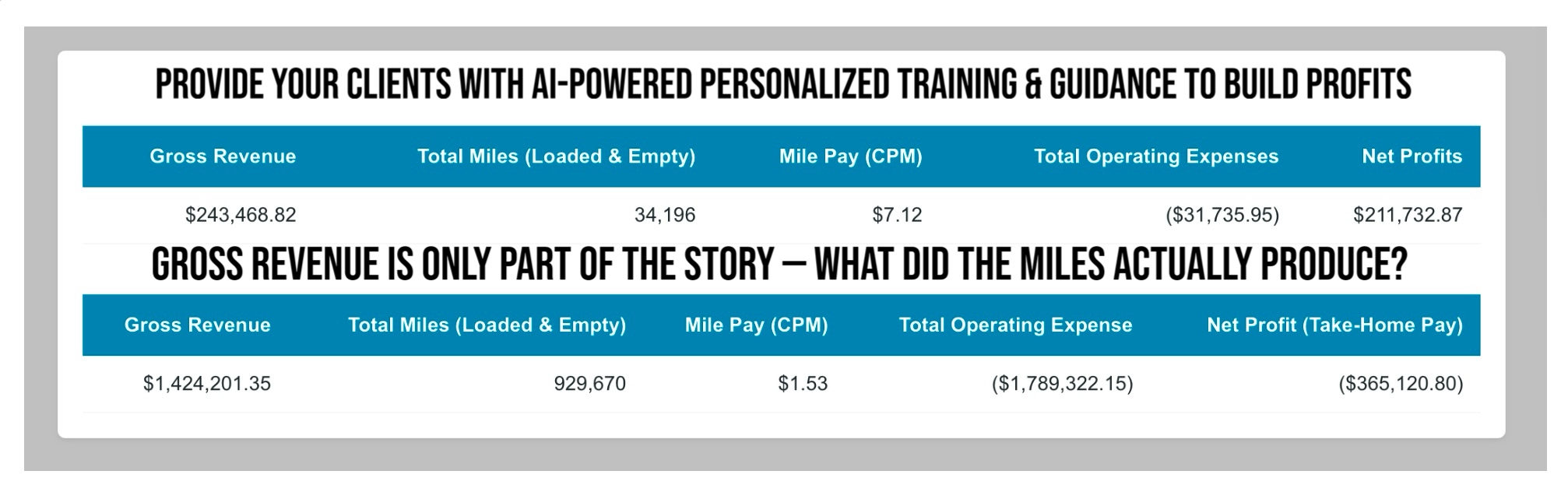
$94,963.62 in gross revenue across 12,337 total operated miles.

That equals approximately $7.70 in gross revenue per total mile.

This example demonstrates why measuring loaded and empty miles together provides a more complete revenue-per-mile picture.

However, gross revenue per mile is not the same as profit per mile.

Operating expenses must also be considered.

Example Conversation

David: Tanya, these results show $94,963.62 in gross revenue across 12,337 total miles.

Tanya: That's a strong amount per mile.

David: It is a strong gross revenue figure. But the important question is what remained after operating expenses.

Tanya: So I shouldn't judge my business only by gross revenue?

David: Exactly. Your goal is to understand what your own operation is producing, not assume another truck's results apply to you.

Historical examples demonstrate what was recorded. They do not guarantee that another Owner Operator will achieve similar results.

8. THE COMPLETE SALES CONVERSATION

David — Eye1 Service Provider
Tanya — Owner Operator

David: Tanya, how long have you been operating your truck?

Tanya: About five years.

David: After all the loaded and empty miles you drive, do you know exactly what your trucking business is producing?

Tanya: I know what I gross every week.

David: That's important. But do you know whether those miles are actually building profits?

Tanya: Not always.

David: Have you ever grossed good money and still wondered where it all went?

Tanya: Plenty of times.

David: That's why I wanted to introduce you to Eye1. We help Owner Operators understand their actual operating results instead of looking only at gross revenue.

Tanya: How does it work?

David: We begin by personalizing your operation with your truck information and expenses. Then you submit your completed loads through the Owner Operators app.

Tanya: What does that show me?

David: It helps you follow your PES, which indicates whether your submitted operating results are moving in a positive or negative direction.

Tanya: What if it's negative?

David: Then we review the information to understand what may be contributing to the losses.

Tanya: Will it tell me how much money I'm making?

David: It helps you evaluate your operating results using the information you provide. The more accurate and complete your submissions, the more useful the results become.

Tanya: What about my empty miles?

David: Those matter too. If your truck drives the miles, they need to be considered when evaluating the operation.

Tanya: That makes sense.

David: If you could begin understanding what your miles are producing instead of just watching your gross revenue, would that help you?

Tanya: Yes.

David: Then let's review the service, the current price, and what is included. If it fits your needs, we can personalize your operation and begin with your next completed load.

9. HANDLING QUESTIONS AND OBJECTIONS

"I Already Know My Numbers."

That's good. Do your numbers include every completed load, all your loaded and empty miles, operating expenses, and the direction of your overall operation?

"I Just Need Better-Paying Loads."

Better-paying loads can help, but how do you determine whether the rate is enough for your actual operating expenses?

"My Dispatcher Handles Everything."

Your Dispatcher may handle bookings, but understanding your business results is still important. If your Dispatcher manages your bookings and submissions through Carriers Dispatch, that is a separate Dispatcher-managed service.

"I Don't Have Time to Submit Loads."

I understand. But without consistent information, it becomes harder to know what your operation is actually producing. The purpose of submitting completed loads is to help you make better-informed decisions.

"I Already Use a Spreadsheet."

That's useful. The question is whether your current system helps you consistently follow completed loads, total miles, expenses, and operating direction.

"I Need to Think About It."

Of course. Is your main concern the price, the time required, or whether the service will provide information you can use?

10. CLOSING THE SALE AND ACTIVATING THE CLIENT

The close should focus on the problem the Owner Operator wants to solve.

David: Tanya, you told me you want to understand where your money is going, include your empty miles, and recognize when your operating results are getting worse. Is that correct?

Tanya: Yes.

David: Do you see how following your actual operating information and PES could help you understand those problems?

Tanya: Yes.

David: Then let's review the current price and service terms. If everything makes sense, we can get your account started.

After the client agrees, complete the following steps:

  1. Create or access the Owner Operators app account.
  2. Verify the truck and starting odometer.
  3. Enter accurate operating expenses.
  4. Explain how to submit every completed load.
  5. Demonstrate how to view PES.
  6. Review the first completed-load submission.
  7. Explain how to maintain accurate information over time.

Be clear about any app charges, training fees, recurring services, and what is included.

The client is already driving the miles. The next step is learning what those miles are producing.

11. THE FIRST 30 DAYS

Week 1 — Establish Accurate Information

Personalize the operating profile, verify the odometer, and begin submitting every completed load.

Week 2 — Understand PES

Review the operating direction and explain what positive or negative results mean.

Week 3 — Review Operating Decisions

Discuss how completed loads, empty miles, fuel, freight rates, and expenses affect results.

Week 4 — Evaluate Progress

Review the information submitted during the month and identify operating patterns.

The first thirty days are about developing consistent habits and learning to understand the results.

12. SUMMARY AND CONCLUSION

Owner Operators do not need to be convinced to drive more miles.

They are already driving, booking loads, paying expenses, and working to keep their businesses operating.

What many need is a clearer understanding of what their work is producing.

Eye1 helps Owner Operators connect completed loads, total operated miles, expenses, and PES to understand their operating direction.

The goal is not to promise that every load will be profitable.

The goal is to help Owner Operators recognize what is happening in their business so they can make better-informed decisions.

FINAL SALES MESSAGE

"You already own the truck. You're already driving the miles and paying the expenses.

But after all that work, do you know whether your trucking business is actually building profits?

Eye1 helps you understand what your loaded and empty miles are producing by using your own operating information.

Why keep guessing when you can start measuring your results?"

EYE1 OWNER OPERATORS
DON'T JUST DRIVE FOR REVENUE. LEARN HOW TO BUILD PROFITS.

Results depend on accurate operating information. Eye1 does not guarantee earnings or profitability.


PROSPECT SERVICE INVITES - d53 (OPEN / CLOSE)
To Send a Website Text Link EDIT, then check the T box, then MODIFY, this text includes your Agent Client ID. (Button Info - Click Here)
USDOT – Search Common Carriers by MC or USDOT number.
FMCSA – New Trucking Authority Records
DOWNLOADS – Download marketing videos / pictures (requires passcode for access). Use the script above for converting prospects.

NEW PROSPECT - STARTING QUESTIONS
COMPANY DRIVERS - STARTING QUESTIONS
  1. Thinking about buying your own truck? Do you know how to make the trucking business profitable BEFORE risking thousands of dollars?
  2. Would you rather learn how to build profits while driving your employer's truck, or wait until you're responsible for all the expenses?
  3. If you could learn how to evaluate loads, operating costs, and loaded and empty miles BEFORE buying a truck, would you want to start now?
OWNER OPERATORS - STARTING QUESTIONS
  1. After driving thousands of loaded and empty miles and grossing thousands of dollars, do you ever wonder, "WHERE DID ALL THE MONEY GO?"
  2. Do you know RIGHT NOW whether your trucking business is building profits or losses?
  3. If fuel prices rise or freight rates drop, do you know how to adjust your operating decisions to protect your profits?

BUILD TRUST BEFORE PRESENTING THE SERVICE.

Ask follow-up questions about the prospect's answers. Listen carefully, understand their goals and challenges, and focus on how you can help them.
Load Analyzer

Copyright © Eye1 Profit Systems LLC


Priority #1 in business is simple: build consistent profits and eliminate massive losses.

Settings

Logo Header


Navbar Header


Sidebar